

Create Clarity in a World of Complexity.
I believe ambition should create freedom — not complexity. By making direction, choices and execution explicit and connected, organizations can create the clarity needed for more predictable performance.

Create Clarity in a World of Complexity.
I believe ambition should create freedom — not complexity. By making direction, choices and execution explicit and connected, organizations can create the clarity needed for more predictable performance.
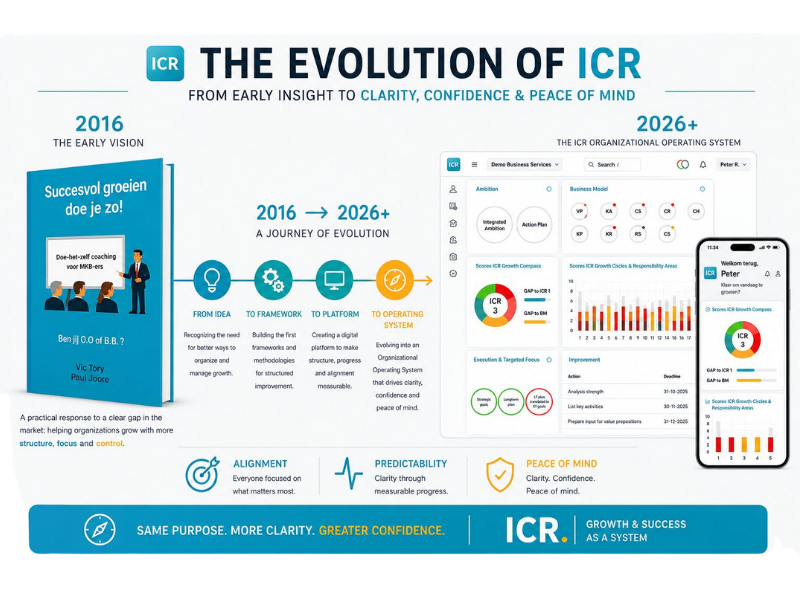
The Evolution of ICR
The Evolution of ICR
Where the ICR Journey Began
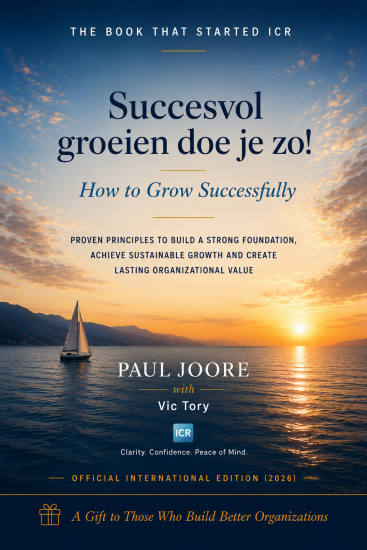
In 2016, I published Succesvol groeien doe je zo! — the first public expression of ideas that would later evolve into the ICR Organizational Operating System. The book laid out an early framework for structured and sustainable growth. Years of application, learning and refinement developed those ideas into an integrated system connecting ambition, business model, strategy and execution.
Succesvol groeien doe je zo!
What started in 2016 as an early vision around structured and sustainable growth gradually evolved into ICR:
an Organizational Operating System designed to help organizations create more clarity, alignment, confidence and peace of mind as complexity grows.
Over the years, the focus evolved beyond structure alone — towards understanding the organization as an integrated system in which ambition, business model, strategy and daily execution are explicitly connected.
Sustainable performance is rarely created by coincidence.
Predictability is designed.
Paul Joore: From Ambition to Alignment
I’ve always been driven to help people grow, feel supported, and perform at their best — with clarity, rhythm, and confidence.
That drive didn’t begin in boardrooms. It started in top-level hospitality, where timing, warmth, and service define success. Helping people feel seen and supported became part of who I am.
Sports added another layer: discipline, teamwork, resilience, and the habit of continuously raising the bar — professionally and personally.
After studying Business Economics and completing a Post-Master in Accountancy, I joined Arthur Andersen. There, I learned how organizations really work beneath the surface: structures, behavioral patterns, hidden bottlenecks, and cultural dynamics that rarely show up on paper.
Repeating pattern
As CFO of a 300-employee organization, responsibility became tangible. Later, as an interim manager and coach across SMEs, corporates, and scale-ups, the same pattern kept repeating itself:
Unique combination
Financial scans confirmed it. Mentoring founders at Startupbootcamp confirmed it again. Different symptoms — the same underlying problem: organizations rarely connect ambition, business model, strategy and daily execution as one integrated system.
While shaping what would later become ICR, I experienced these struggles personally. The pressure. The chaos. The tension between short-term survival and long-term ambition. The constant search for clarity, balance, and rhythm.
At one point, I was told I couldn’t speak about entrepreneurial pain because I hadn’t lived it myself. Today, the opposite is true. I didn’t just design ICR — I lived the very problems it was built to solve.
At the same time, I could only build it because of what came before: my academic background, auditing experience, CFO role, interim leadership, and coaching work.
That combination allowed me to see the system behind sustainable organizational success — long before I experienced the pain personally.
The ICR Organizational Operating System
In my forties, after a period of deep personal and professional growth, one question became unavoidable: What legacy do I want to leave behind?
If no integrated, practical system existed to help organizations grow with clarity, rhythm, and sustainable performance … I would build one.
That system became ICR — an Organizational Operating System that provides the architecture to make ambition, business model, strategy and execution explicit and connected. Not just to assess organizations, but to help them function as integrated systems and create more predictable performance.
Why I developed ICR
My vision is simple: when people want to achieve something that matters to them, they want their performance and results to be as predictable as possible. That belief became the foundation of ICR — an Organizational Operating System designed to create clarity, build confidence and enable more predictable performance and results.
Ambition without structure doesn’t create freedom — it creates pressure.
Grounded in Practice

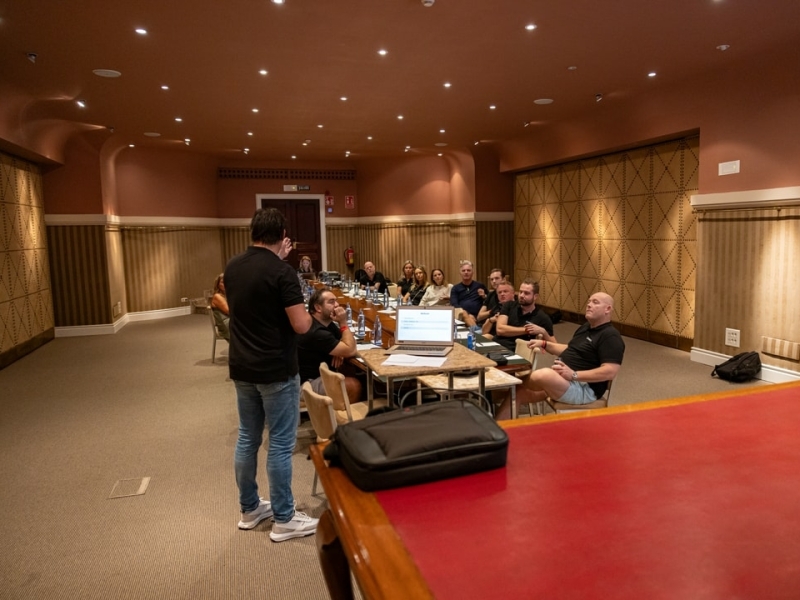
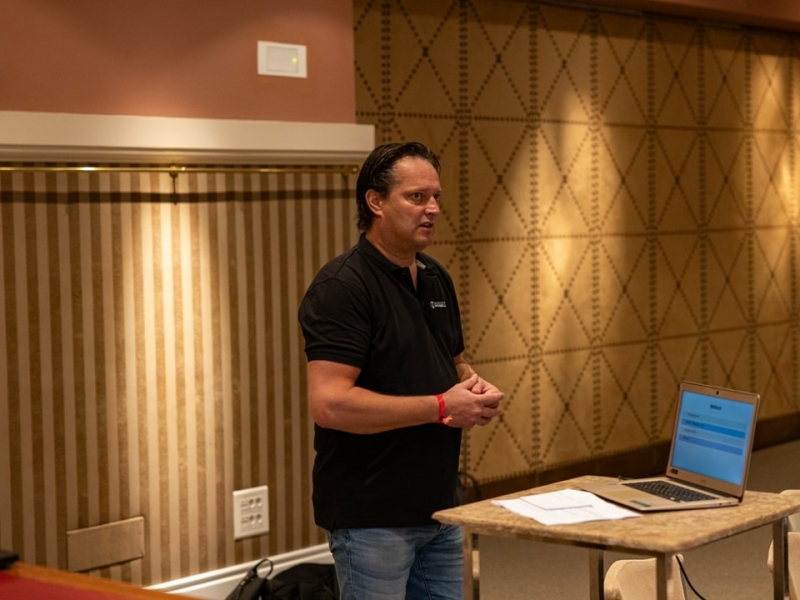
Building and mentoring founders in high-pressure growth environments
Building and mentoring founders in high-pressure growth environments

Designing and shaping organizational systems that scale with ambition

Leading organizations as CFO and interim executive through complexity